
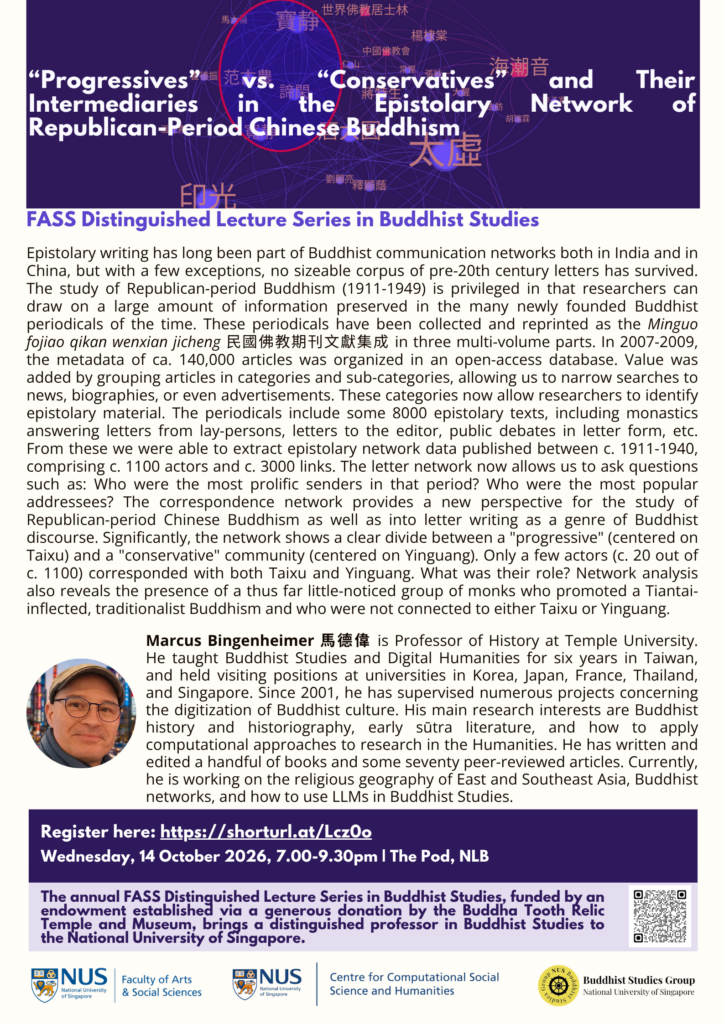
'Progressives' vs. 'Conservatives' and Their Intermediaries in the Epistolary Network of Republican-Period Chinese Buddhism
- 14 October 2026, 7:00 PM to 9:30 PM
- The POD @ National Library Board | 100 Victoria Street, Level 16, Singapore, 188064
- Registration
Programme
7:00 PM | Registration |
7:30 PM | Welcome Remarks by Associate Professor Han Chao, FASS Assistant Dean of Research (NUS Department of Chinese Studies) |
7:35 PM | Opening Remarks by Associate Professor Jack Meng-Tat Chia, Chair of Buddhist Studies Group (NUS Department of History) |
7:40 PM | Lecture by Distinguished Speaker, Professor Marcus Bingenheimer (Temple University) |
8:30 PM | Q & A and Discussion |
9:00 PM | Refreshments |
9:30 PM | End of Event |
Abstract:
Epistolary writing has long been part of Buddhist communication networks both in India and in China, but with a few exceptions, no sizeable corpus of pre-20th century letters has survived. The study of Republican-period Buddhism (1911-1949) is privileged in that researchers can draw on a large amount of information preserved in the many newly founded Buddhist periodicals of the time. These periodicals have been collected and reprinted as the Minguo fojiao qikan wenxian jicheng 民國佛教期刊文獻集成 in three multi-volume parts. In 2007-2009, the metadata of ca. 140,000 articles was organized in an open-access database. Value was added by grouping articles in categories and sub-categories, allowing us to narrow searches to news, biographies, or even advertisements. These categories now allow researchers to identify epistolary material. The periodicals include some 8000 epistolary texts, including monastics answering letters from lay-persons, letters to the editor, public debates in letter form, etc. From these we were able to extract epistolary network data published between c. 1911-1940, comprising c. 1100 actors and c. 3000 links. The letter network now allows us to ask questions such as: Who were the most prolific senders in that period? Who were the most popular addressees? The correspondence network provides a new perspective for the study of Republican-period Chinese Buddhism as well as into letter writing as a genre of Buddhist discourse. Significantly, the network shows a clear divide between a “progressive” (centered on Taixu) and a “conservative” community (centered on Yinguang). Only a few actors (c. 20 out of c. 1100) corresponded with both Taixu and Yinguang. What was their role? Network analysis also reveals the presence of a thus far little-noticed group of monks who promoted a Tiantai-inflected, traditionalist Buddhism and who were not connected to either Taixu or Yinguang.
Speaker Bio:
Marcus Bingenheimer 馬德偉 is Professor of History at Temple University. He taught Buddhist Studies and Digital Humanities for six years in Taiwan, and held visiting positions at universities in Korea, Japan, France, Thailand, and Singapore. Since 2001, he has supervised numerous projects concerning the digitization of Buddhist culture. His main research interests are Buddhist history and historiography, early sūtra literature, and how to apply computational approaches to research in the Humanities. He has written and edited a handful of books and some seventy peer-reviewed articles. Currently, he is working on the religious geography of East and Southeast Asia, Buddhist networks, and how to use LLMs in Buddhist Studies.
About the FASS Distinguished Lecture Series in Buddhist Studies:
The annual FASS Distinguished Lecture Series in Buddhist Studies, funded by an endowment established via a generous donation by the Buddha Tooth Relic Temple and Museum, brings a distinguished professor in Buddhist Studies to the National University of Singapore.