Computational Social Simulations for Aiding Policy Design
People Involved:
- Prof Atreyi Kankanhalli, Dept. of Information Systems and Analytics, National University of Singapore
- Prof Kenneth Benoit, School of Social Sciences, Singapore Management University
- Prof Winston Chow, Urban Systems, Singapore Management University
- Assoc Prof Miguel Escobar Varela, Dept. of English, Linguistics and Theatre Studies, National University of Singapore
- Assoc Prof Goh Khim Yong, Dept. of Information Systems and Analytics, National University of Singapore
- Assoc Prof Alastair Gornall, Humanities, Arts and Social Sciences, Singapore University of Technology and Design
- Assoc Prof Jiang Shaohai, Dept. of Communications and New Media, National University of Singapore
- Dr Justin Lee, Institute of Policy Studies, National University of Singapore
- Assoc Prof Kim Hye Kyung, Wee Kim Wee School of Communication and Information, Nanyang Technological University
- Assoc Prof Soujanya Poria, School of Electrical & Electronic Engineering, Nanyang Technological University
- Assoc Prof Qiao Dandan, Dept. of Information Systems and Analytics, National University of Singapore
- Dr Kiruthika Ramanathan, School of Computing and Information Systems, Singapore Management University
- Asst Prof Araz Taeihagh, Lee Kuan Yew School of Public Policy, National University of Singapore
- Assoc Prof Tan Chuan Hoo, Dept. of Information Systems and Analytics, National University of Singapore
Funder
MOE Social Science Research Council Special Programmatic Grant
Duration
July 2026 – June 2031
Description
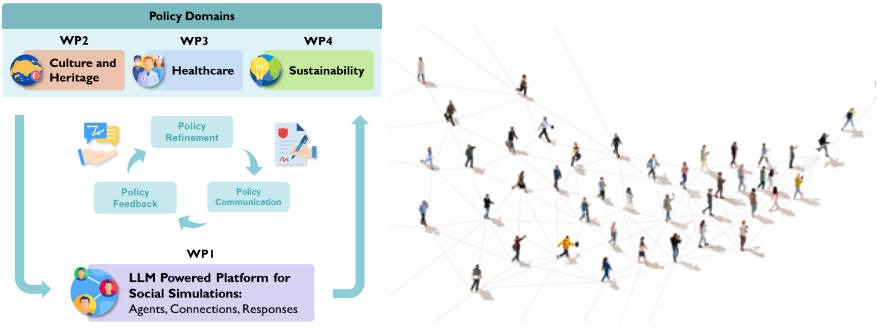
Governments worldwide are confronted with challenges in communicating, assessing, and adapting policies to public feedback. An increasingly turbulent global outlook has heightened the importance of swift and cost-effective, evidence-based policymaking. Yet, diverse views and information saturated environments impede governments in gauging public response to policy initiatives. In the face of wicked problems such as societal cultural divides, chronic healthcare burden, and sustainability issues, there is a crucial need for gaining data-driven insights for policy design and evaluation. Policy gaps can lead to public resistance, decreased effectiveness, and erosion of trust in government. Balancing the objective of efficient policy implementation with the need for participatory design e.g., through traditional methods like large-scale surveys and experiments that entail significant time and costs, presents a significant hurdle. Rapid advances in large language models (LLMs) offer a significant opportunity to simulate social systems to complement traditional methods for aiding policy design and assessment. However, the efficacy of these approaches is unclear and lacks investigation in the policy domain. To this end, we propose a comprehensive research programme in which our objective is to develop and validate an LLM-based social simulation platform for assisting policy makers in three example domains. This programme is novel in taking an interdisciplinary approach involving: (1) using LLMs for theory-driven modelling and simulation of diverse public responses to policies, (2) validating the results from the computational simulation models with real data, (3) analysing feedback to generate insights for policy design, and (4) assisting policy makers for adapting their policy strategies. We aim to advance policy design and evaluation by aiding policymakers to anticipate and mitigate possible negative consequences.